The Apennine mountain chain runs roughly 1,200 kilometers through the length of the Italian peninsula, and for most of recorded history, it has been threaded by thousands of small streams that descend quickly from ridgeline to valley. Those gradients — often 5 to 15 percent over short distances — made the Apennines unusually well suited to water-powered milling. The physics are straightforward: faster water, steeper drops, and consistent flow from snowmelt and spring rain created ideal conditions for the overshot wheel, the most efficient of the three classical wheel types.
Wheel Typology in the Apennine Context
Medieval European mill builders recognized three main wheel configurations: the undershot, breastshot, and overshot wheel. Each requires a different relationship between the mill structure and the stream.
The undershot wheel sits directly in the current, relying on the kinetic energy of flowing water. It is the simplest to build — no headrace, no weir, no elevation management — but also the least efficient, capturing perhaps 20 to 30 percent of available energy. On wide, slow rivers in the Po Valley, undershot wheels were common precisely because the streams did not offer sufficient drop for anything more sophisticated.
In the Apennines, the terrain permitted better. Overshot wheels — where water is delivered from above through a flume and falls onto the wheel's buckets — can capture 60 to 80 percent of the water's potential energy. The wheel is turned primarily by the weight of water in the buckets rather than by its velocity, which means a relatively modest flow can do meaningful work as long as there is adequate head — that is, enough elevation difference between the water source and the wheel.
Millers in the high Apennines around Norcia and Spoleto were operating overshot installations by the 11th century. Stone corbels and wheel-axle sockets recovered during surveys in the 1980s confirm wheel diameters of four to six meters — consistent with overshot design.
Structural Patterns Across the Region

A mill wheel in operating condition. Wheel diameter, material, and bucket geometry varied considerably by region and available timber. (Wikimedia Commons, CC)
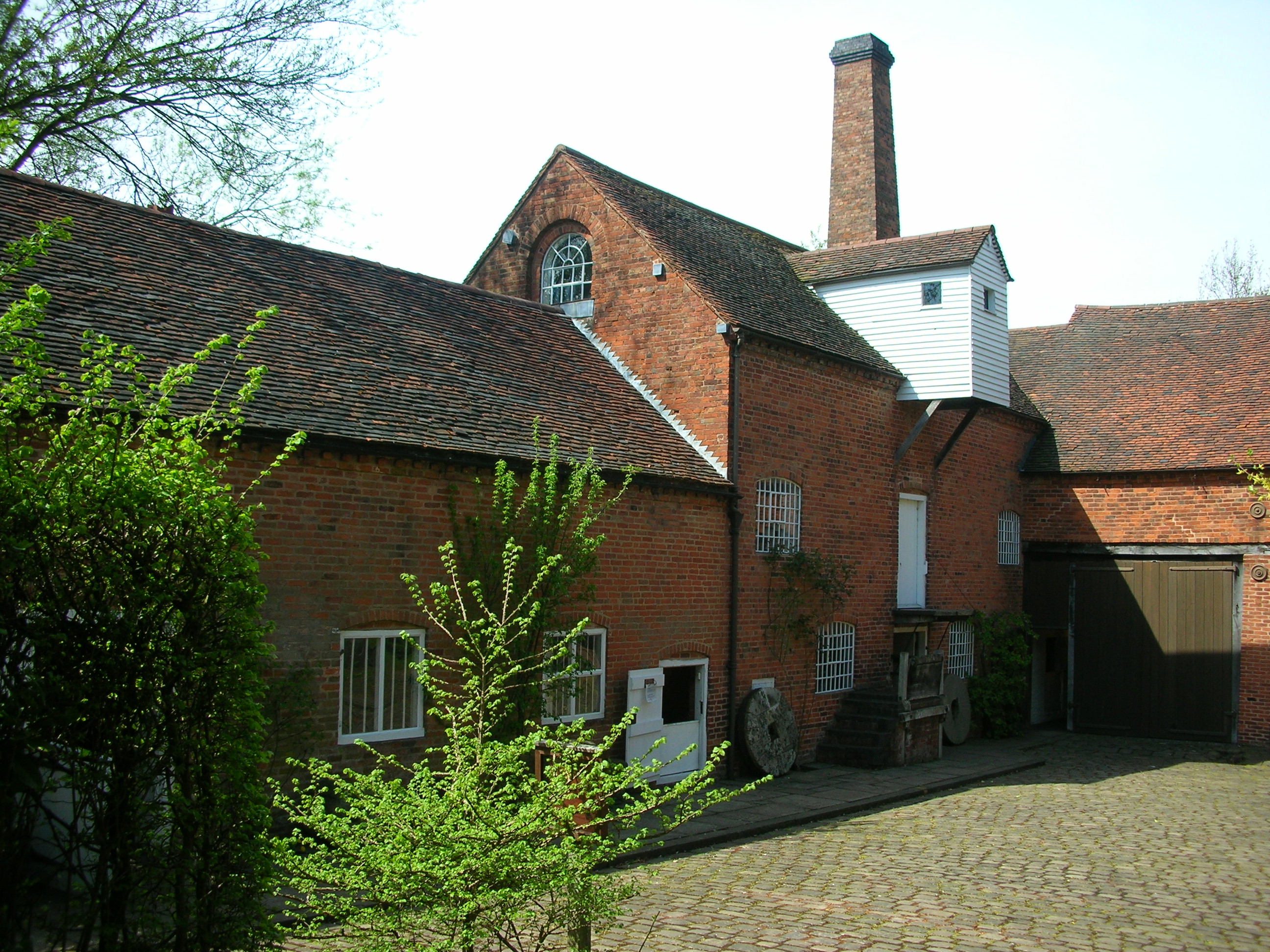
Apennine mill buildings share several architectural features that reflect both the region's geology and the demands of mill operation. The buildings are almost invariably stone, because timber was not available in sufficient quantity at the altitudes where mills were most productively sited. Limestone and sandstone from local outcrops form the walls, and the floor plan is typically narrow and elongated, oriented to allow the headrace to enter at one end and the tailrace to exit at the other.
The millroom proper — where the grinding stones were installed — was almost always on the ground floor. A separate chamber below or adjacent housed the wheel axle and pit wheel, the primary gear connecting the water wheel to the millstone shaft. Access to this sub-floor chamber was essential for maintenance, and many surviving structures retain a low arched doorway on the stream-side elevation.
The Headrace and Flume
The headrace — the channel that delivered water to the wheel — was the critical piece of civil engineering for any Apennine mill. Its construction determined the effective head, the flow rate, and therefore the mill's throughput. Most headraces in the region were cut from local stone and sealed with lime mortar, though earlier examples used timber-lined channels that have not survived.
The flume itself — the final delivery channel above the wheel — was almost always made of wood, typically chestnut or oak. Chestnut was preferred in central Italy because of its natural resistance to rot in wet conditions. The flume angle and exit aperture controlled the rate of water delivery to the wheel, and experienced millers adjusted a hinged sluice at the flume's entrance to regulate throughput during high-flow periods.
Millstones: Local and Imported
Two millstones form the heart of any grain mill. The bedstone is fixed; the runner stone turns above it, and the grain is introduced through a central hole in the runner called the eye. The gap between the stones — the dress — determines the coarseness of the resulting flour and had to be adjusted regularly as the stone surfaces wore.
In central Italy, quarries near Orvieto and in the Monti Sibillini supplied sandstone millstones of reasonable quality. However, the most prized stones in northern and central Italy were imported from France — specifically from the La Ferté-sous-Jouarre region, which produced a hard, porous freshwater quartz known as buhrstone. French buhrstone imports are documented in Lombard trade records as early as the 13th century, and fragments surface occasionally in archaeological surveys of former mill sites in Emilia-Romagna and Tuscany.
Surviving Structures and Survey Records

Mill interior with grinding stones and drive mechanism visible. Apennine mill interiors followed similar spatial logic, though with local stone rather than timber framing. (Wikimedia Commons, CC)
Systematic survey of Apennine mill heritage began seriously in the 1970s and 1980s, driven partly by the broader Italian interest in vernacular architecture and partly by the growing recognition that these structures were disappearing rapidly. The regional soprintendenze in Umbria, Marche, and Abruzzo compiled inventories that documented hundreds of mill sites — most in partial ruin, some collapsed entirely, a handful in working order or restored.
The surveys revealed a consistent pattern: mill sites cluster along watercourses at intervals of roughly one to three kilometers, corresponding to the natural spacing of weir-viable points on a given stream. Where a stream descends a series of steps in the terrain — a relatively common feature in limestone Apennine country — multiple mill sites sometimes exist within a few hundred meters of each other, each exploiting a different drop.
Post-Unification Decline
The decline of the Apennine mill began after Italian unification in 1861 and accelerated sharply in the early 20th century. Steam-powered mills, later replaced by electric roller mills, could operate continuously regardless of seasonal water levels and could process grain faster and more uniformly than stone-ground systems. The smaller mountain communities that had sustained individual family mills depopulated steadily through the 20th century, and the structures were abandoned as their operators left for urban employment.
A second wave of damage came during the central Italian earthquakes of 1997 and 2016, which affected precisely the limestone Apennine zones where mill concentrations were highest. Some sites documented in the 1980s surveys no longer exist above foundation level.
Ongoing Documentation Efforts
Several Italian regional bodies and university departments continue to survey and record mill sites. The Ministero della Cultura maintains a national inventory of vernacular architectural heritage that includes mill classifications, though coverage is uneven across regions. Some comune have undertaken local restoration projects, particularly where a mill site coincides with a walking trail or nature reserve that attracts visitors.
The most complete documentation tends to exist for sites that were still operational within living memory and where detailed photographic and measured-drawing records were produced before final abandonment. Sites abandoned before the 1950s are more difficult to characterize, and the identification of wheel type, stone diameter, and drive configuration often relies on surviving stonework rather than documentary evidence.